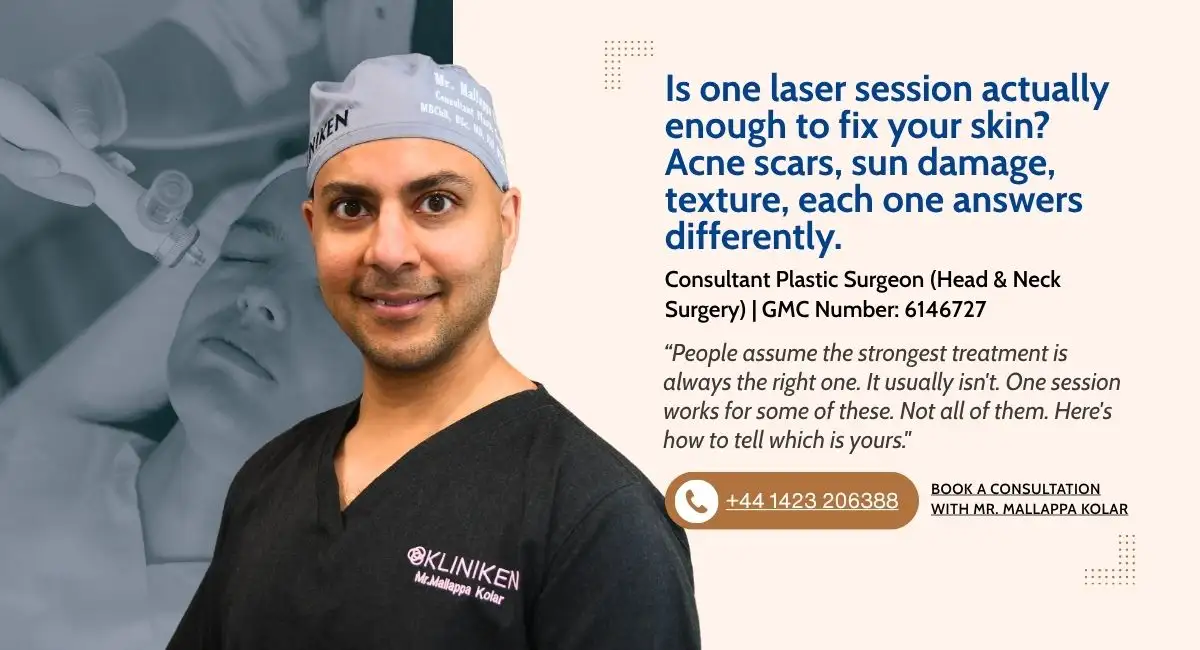
Sometimes yes. Sometimes no. It depends less on the laser and more on what you’re actually treating.
If you have already read our page about why acne scars & uneven skin texture don’t fade on their own, then you already know the “short” version of it. Some skin issues are closer to the surface and therefore they will work better than others, but other issues are more internal for creams to effectively treat the recurring concern.
The previous page did not address the question most people want an answer to.
- What treatment is best for me?
- How many appointment sessions will I need?
Nobody wants to schedule a treatment without an indication as to whether it will require one, two, three or six visits! Here’s an honest answer to the questions we get asked the most concerning these two areas.
Acne scar removal for surgery
Acne scars: the one exception to one session
Acne scars are the most common issue when it comes to skin that has been around for a while. The kind of scarring concealer covers fine until you take a photo with flash. As such, the first line of action in removing them is peels, microneedling and prescription creams and weaker lasers such as the Stellar M22 at the clinic.
If your acne scars are merely discolourations (e.g. redness, purple spots), these may be sufficient. However, if there is actual pitting or texture (i.e., bumps) in addition to discolouration, they will likely not help in isolation.
The problem with most types of acne scarring is that the damaged area is below the surface of the skin, in the dermal layer beneath the surface, where the skin is thinned as a result of the acne processes. Therefore, treatments which simply remove or smooth out the surface of the skin do nothing for the underlying dermis.
Acne scar removal laser surgery addresses this issue by using CO2 laser to stimulate the rebuilding of collagen from underneath the skin as opposed to just smoothing out the top layer of the affected skin. Anyone researching ‘laser for acne scar treatment’ usually lands here for that exact reason. For truly deep scarring, it is one of the best treatments for acne scar removal, rather than treatment as such.
Since the depth of the scarring determines the number of sessions required to effectively treat it, mild scarring generally requires less aggressive methods and thus fewer sessions, usually two to three sessions spaced apart by at least a month. Deeper, older scarring can sometimes produce significant results after only one intense treatment; however, recovery time is significantly greater and are much more likely to need more treatments as the collagen builds up over time.
Whether laser treatment or another type of treatment is “better” is not necessarily determined by how well either works. It is ultimately dependent upon how much downtime you can afford and how much your skin tolerates each method. The old adage that each patient is treated as an individual couldn’t be truer than here!
Sun damage: the closest thing to a one session fix
Sun damage is quite different from acne scars.
Instead of pitting like in acne, for sun damage what you get is pigmentation, broken capillaries and overall uneven skin texture. The kind of patchiness that only shows up properly in direct sunlight, the same sunlight that caused it in the first place.
Left untreated, this kind of sun damage skin pigmentation only gets more noticeable, especially with more sun exposure.This type of damage is may be more noticeable in the summers, but it’s important to remember that in the UK, as we are closer to the North Pole, UV damage can still occur in the winters and when overcast.
We consistently see searches for sun damage skin treatment increase during late summer as the effects of the season and exposure become quite evident on the skin.
Fortunately, most sun damage can be treated at lower intensity than deeper acne scars.
Typically, patients can experience significant improvements from just one and infrequently two treatments.
As such, it takes some time before noticeable improvements become evident and they continue to appear in the weeks and up to 1 year following treatment.
Uneven texture and fine lines : one session, once you know what you are treating
This can be the most difficult to explain and yet easily dismissed, unless it’s seen in the wrong context. Pores are larger. Your skin looks fine under indoor lighting, but not outdoors and feels rougher than before, even when covered by foundation.
More often than not, the reasons for this are numerous. Usually, it’s a mix of early stages of collagen loss combined with years of surface level habits that never really addressed the true underlying issue.
With the CO2 laser we use, texture concerns are usually treated in a single session. That’s different from a broader laser treatment plan involving other equipment, like the M22, which is built around a course of several visits. For texture specifically, one CO2 treatment is typically enough.
Worth saying now that not all uneven patches need to use the most intense treatment options available. Matching the intensity to the depth of the problem being treated is important. Trying to use an option simply because it seems like it will be more thorough is not.

Already know which one is yours? Skip ahead to how to book below.
Surgical and keloid scarring: a different question entirely.
There’s another category of scarring that people rarely talk about, but they still exist. Scars left after caesarean operations, tummy tuck operation or any breast related procedure are also part of the skin issues. Some people search this specifically as C section scar laser treatment. Stretch marks from the same procedures often come up in the same conversation too. They haven’t quite settled completely and this is something that you have observed but haven’t understood why. Surgical scar laser treatment addresses exactly this kind of concern, scars and stretch marks that have healed but never quite faded. Scar revision after a breast lift specifically comes up more than people expect, since visible scarring is one of the most common regrets patients mention once the swelling has gone down.
Keloid scars or hypertrophic scars are part of the same category, even though not completely. They are scars that have thickened and risen beyond the original wound. Laser options here, often searched as keloid scar treatment laser, work by softening that raised tissue rather than removing it outright.
Scar revision using CO2 laser resurfacing works differently to surgical scar removal. By addressing the texture and tone of the skin at the surface, it works further beyond removing the scar tissue. This leaves laser skin resurfacing to be the best option for scars that have healed, but still look shiny, discoloured or raised.
Laser skin resurfacing is not a replacement for surgical scar removal. If your keloid scarring, or any scar, is much more pronounced, then the surgical route may be the better option. This is because both these approaches work differently and solve different problems for you.
There’s a whole lot to discuss only on this aspect of scar removals and revisions using either lasers or surgery and when each of them will work. But if you are facing any issues right now as with scars from a previous surgery, it’s much better to talk to one of our consultant surgeons before we address the procedure.

So how many sessions will you actually need?
Now coming to the real question that you had:
How many sessions will I need for my concern?
We are going to answer you keeping in mind the state of the art CO2 laser resurfacing machine arriving in September 2026 at our clinic in Harrogate.
Our new ULTRApulse Alpha laser has two working modes, and their configuration depends on the problem being treated for you.
- The stronger mode goes deeper in one session itself. For example, for longstanding sun damage or acne scarring, it can deliver real change in a single session. Recovery might take longer, but the results that you will see are much sooner.
- The gentler mode is fractional CO2 laser treatment which usually works for concerns that are texture related, mild scars or for anyone who is more comfortable doing it over two to three sessions with less downtime.
Neither of them automatically are the right ones for you. Stronger isn’t the same as the better one. The right choice depends on your skin type and the recovery intervals.

What is so special about the ULTRApulse Alpha?
The ULTRApulse Alpha is developed by Lumenis. The company has produced CO2 laser technology for over 20 years for aesthetic medicine. This is not a new brand or inexperienced company. Rather they are considered pioneers of CO2 laser technology within aesthetic medicine technology. In fact many clinics in the UK and abroad currently utilise Lumenis’ equipment.
Advantages of the equipment:
- It produces energy as controlled pulses (short duration), rather than as one large pulse.
- Less heat is distributed outside of the target treatment zone resulting in reduced thermal injury to surrounding tissue.
- Less discomfort experienced throughout the procedure.
- Recovery time is significantly faster with newer CO2 laser models compared to older models.
- Provides both full ablation and fractional treatment modalities in the same device.
You can obtain further technical details about the ULTRApulse Alpha directly from the manufacturer at www.lumenis.com/aesthetics/products/ultrapulse-alpha.
Wondering what this would actually look like for your skin?
How many sessions you’d need depends on what’s being treated, and that’s not something a blog post can answer for you. A consultation gives you an actual plan, specific to your scars or texture.

Arriving at Kliniken this September
The ULTRApulse Alpha lands at Kliniken in Harrogate this September. If you’re travelling in for CO2 laser resurfacing from Leeds or elsewhere in North Yorkshire or indeed anywhere in the North of England, you’re welcome here too, as we are the only private site in the North of England with this in the private sector.
Treatments run from October through to March.
You don’t have to wait until then to get answers. A consultation can happen sooner. Treatment itself just can’t start until the laser physically arrives.
Joining the waitlist
If any of this sounds like your skin, you don’t have to wait until October to do something about it.
The cost of CO2 laser skin resurfacing at Kliniken is as follows:
- Full face and neck resurfacing costs £4,500.
- Face only is £4,000.
A consultation costs £200. On its own that’s not refundable, but if you go ahead with treatment within a year, it comes straight off your final price.
Join the waitlist now and you’ll also get £500 off your first treatment on top of that.
JOIN THE WAITLIST
Frequently asked questions
- How many sessions will I actually need?
It depends what you’re treating & how deep it goes. Acne scars & sun damage vary session to session. We’ll confirm what’s realistic once we’ve actually looked at your skin. - Does it hurt and how much downtime does it need?
There’s some discomfort, mostly described as heat rather than pain. Downtime depends on the mode used, from a few days up to around two weeks for the strongest setting. - How much for CO2 laser treatment at Kliniken?
Full face & neck is £4,500, face only is £4,000. The £200 consultation fee comes off that if you book within a year, plus you get £500 off for joining the waitlist now. - When can I actually book treatment?
The machine will be here September, but joining the waitlist now means you’re seen early once appointments open & you lock in the £500 discount. - Is the £500 discount only available now?
Yes. It’s available to everyone who joins the waitlist ahead of the October launch.
So how many sessions would you need?
Book now for a consultation with our expert surgeons and avail the waitlist discount for the treatment and personalized consultation with our team.