Fractional CO2 Laser vs
Fully Ablative CO2 Laser
What’s the Difference, What It Means for Recovery, Results
If you’re searching for a fractional CO2 laser vs a fully ablative CO2 laser, you’re already past the basics. You’ve come to the right place if you are interested in understanding what these terms are, why one of them implies more downtime, why the other will require more sessions, and what exactly changes in the skin. This page describes the mechanism, trade-offs, and logic of safety behind the choice of one approach over the other.
Jump to section
What CO2 laser resurfacing actually does
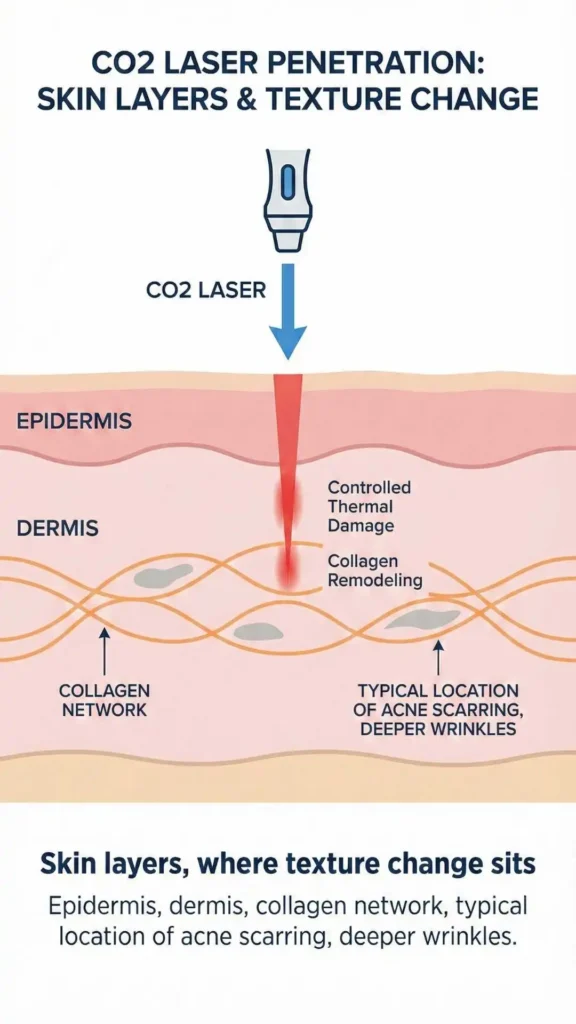
CO2 laser resurfacing is a procedure that uses a carbon dioxide laser, which delivers a specific amount of thermal energy to your skin. It aims to help with collagen remodelling and surface renewal, enhancing skin texture.
A useful way to think about it:
- The wrinkles and the scars are not vaporised with the laser.
- It repairs the skin.
- The repair response is where you find the treatment working on the skin.
The key lever is control:
- The extent of treating the skin.
- How far does it permeate the impact on your skin?
- The quantity of heat provided locally is enough to cause damage.
- The manner in which it is applied evenly in design.
Fractional CO2 laser vs Fully Ablative CO2 laser
Fractional CO2
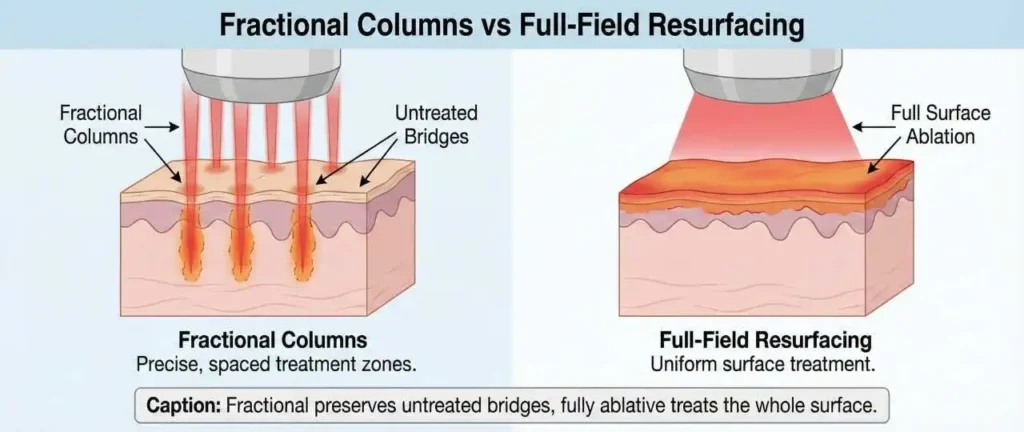
Fractional CO2 acts in small areas of skin in grid formation leaving bridges between tiny areas that have been treated.
What that means in practice:
- Rapid recovery compared to treatment of the whole surface
- Frequently less serious downtime
- Typically multiple sessions on more serious issues
Fully Ablative CO2
Fully Ablative CO2 eliminates the complete outer skin of the whole area of the treatment device, not just the columns.
What that means in practice:
- More intensive resurfacing
- Increased aftercare, increased recovery
- Used frequently in deeper textural problems where lighter approaches level off
Important reality
“ “Stronger” is not always “better.” Stronger is simply stronger. The correct choice is the safest intensity that matches the problem depth.
Depth, Density, Intensity, what settings really change
Marketing often frames this as an XYZ device from one brand versus an ABC device of another brand. Clinically the bigger drivers are settings on the device being used.
Depth
Column reach of the micro injuries. More deep settings can address more profound texture issues as well as heighten the healing need.
Density
Columns in fractional treatments in numbers. Higher density may add to the visible effect but could also add on to the downtime.
Energy, pulse duration
The effects of these are on thermal spread, tissue response along with the risk profile.
Coverage area
The face only differs from just the face and neck. Skin thickness and healing behaviour is quite different in both.
Recovery differences, what is realistic
It can’t be stated more, but the fact is recovery is the part where trust is won and lost. This is one of the aspects that shall never be looked over.
Fractional CO2 Laser
- Feeling hot, red and being swollen
- Peeling and harsh texture during the healing process
- Social downtime that changes in intensity of the process done
Fully Ablative CO2 Laser
- More noticeable redness and swelling
- Longer phase of re-epithelialization
- More organised follow-up care and care after surgery
Two realities matter:
- Time of recovering depends on the intensity and the skin type and adherence to aftercare.
- Part of the redness may not fade within a time period that the skin may seem cured even when the surface is no longer darker.
This is not meant to scare you. It is supposed to maintain the level of expectation so that you guard your calendar and guard your skin.
Who each option tends to suit
Fractional CO2 is usually thought of in case of:
- Skin texture concern is mild to moderate.
- Patients like to see gradual improvement.
- Caution or slow increase in risk profile.
Fully ablative CO2 is usually thought in case of
- Texture concern is more profound and long standing.
- Previous treatments done have reached their saturation limit.
- The cost of increased downtime is acceptable and something that can be worked by both parties involved.
Suitability also depends on:
- Skin type, pigmentation risk
- Medical history and healing manner.
- Lifestyle limitations.
Risks, limitations, what it cannot promise
CO2 laser may assist in the treatment of texture, scarring along with fine lines. What it doesn’t promise is:
- A perfectly done skin
- Complete elimination of scars.
- Almost zero downtime
- Same results for all skin types.
Frequently occurring risks which have to be addressed in a reputable environment:
- Redness for a long time
- Pigmentation alterations particularly on the skin types prone to higher risks.
- Risk of catching an infection in case of poor aftercare.
- There is a danger of scarring in rare cases that is normally associated with improper settings, wrong selection of candidates and extremely poor aftercare.
A good clinic sets the right boundaries before they start. That’s not negativity. That’s competence to be measured.
Misconceptions we see often
“Fractional means no downtime.”
False. It means potentially less downtime depending on the intensity used.
“Fully ablative is always best.”
False. It is simply more aggressive and more demanding, not automatically better.
“If my last treatment failed, nothing will work.”
Often false. The mismatch is commonly treatment depth versus problem depth.
“The brand of laser is the main factor.”
Often false. Settings, technique, candidate selection and aftercare drive outcomes more than the device name.
Why CO2 is used beyond aesthetics
CO2 laser is not just a form of cosmetic technology used for scar treatments. It has been a long standing medical technology where managed resurfacing is clinically feasible which includes scar management in certain use cases.
This matters a lot in aesthetic because it reframes the discussion:
- Co2 laser resurfacing is not “beauty tech”
- It is a managed tissue remodification
In case you want to check the registration of a clinician, refer to the General Medical Council register. In general health advice the NHS gives some basic information on healing the skin, scarring, safety of procedures regardless of the fact that these will not be the same as private clinic procedures.
Next step
If you came here to understand the terminology, you now have the core framework:
- Fractional treats columns as bridges of skin remain
- Fully ablative treats the full surface of your skin
- Settings decide the intensity, intensity drives the downtime, the risk involved and the aftercare needed
How CO2 laser pricing
is decided
Understand what influences cost beyond the number on the page — including treatment depth, session planning and clinical oversight.
View pricing breakdownCompare CO2
laser options
See how fractional and fully ablative CO2 lasers differ in cost, recovery time and suitability.
Compare treatmentsDiscuss suitability
before committing
Pricing only makes sense once your skin type, recovery window and expectations are understood.
Contact us now